
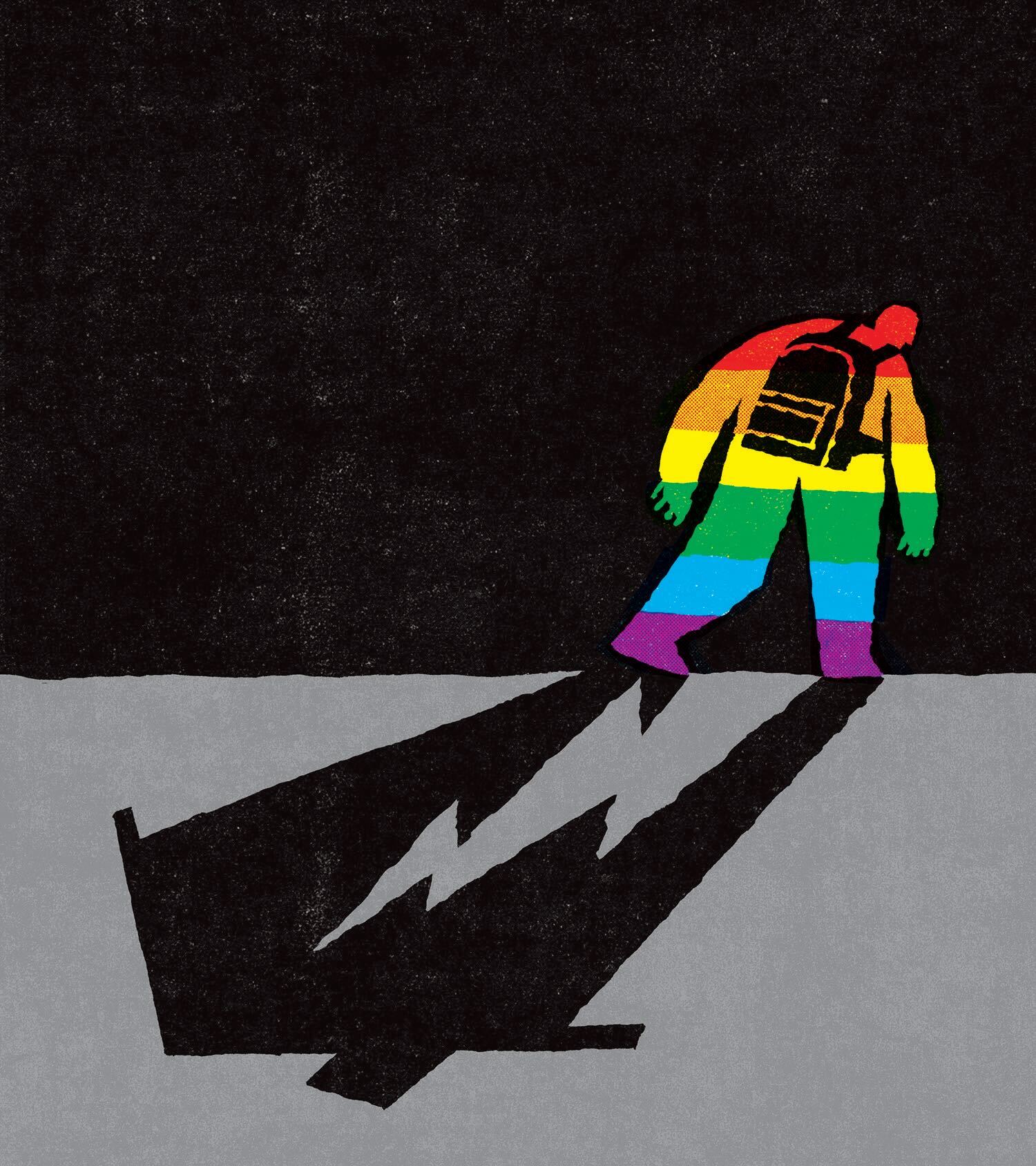

ATLANTA — Although the city of Atlanta has claimed that overall youth homelessness (ages 18-24) has decreased by 6% in the past year, non-profit organizations servicing LGBTQ+ homeless youth said they’ve seen a consistent increase annually for the past five years in queer-identifying children needing care.
“[LGBTQ+ youth are] 120% more likely to experience homelessness than any other group of young people.” said Katie Leyton, Director of Development at Covenant House Georgia.
Covenant House Georgia is one of the many resource centers that provide housing opportunities for the vastly underrepresented LGBTQ youth in the Atlanta metro area. Other organizations include Lost-N-Found, The Trans Housing Coalition and AidsAtlanta.
One of the challenges these organizations have to deal with while trying to address the issue of queer youth homelessness is obtaining accurate data and information—which is even more difficult if the statistics are underreported.
Efforts made to address information gaps
“Back in 2014, I was asked by a bunch of LGBTQ advocates about the possibility of doing a dedicated youth count,” said Professor Eric Wright, Chair of the Department of Sociology at Georgia State University (GSU).
Wright teamed up with another GSU professor, Nicholas Wagner, and assembled a team of colleagues to conduct a study after the nonprofit consortium The Atlanta Coalition for LGBTQ Youth (ACFLY) noted that there was an influx of LGBTQ youth showing up to the hospital emergency room claiming to be homeless.
This prompted Wright’s team to commission a group of GSU students to canvas Atlanta’s queer youth population to get a more precise scope of how many kids needed housing.
The initial 2015 study led by Wright and his team found 3,300 youth between the ages of 18 and 25 who were homeless, 2,500 more than a [year] report from Partners for Home (POH), a non-profit organization funded by Atlanta’s municipal government.
POH’s survey was done in only one day in [year]and reported 585 homeless youth under the age of 24, while the GSU study was done over a three-month time period in [month X to month Y in year]
While this miscount of homeless youth in Atlanta is a major issue, experts said there are two major challenges to more accurate reporting:
No uniform definition for homelessness
“If you actually dive into both the 2015 and 2018 reports, you’ll see that about a third of the youth were in motels and another random percent were also sofa surfing,” Wright said. “We had a very liberal definition of [homelessness], because some of the youth stories were actually quite complicated.”
Couch surfing, motel lodging, and sleeping in cars are some of the tactics homeless youth use to stay undetected and can inhibit the accuracy of statistics due to their mobility. Wright also said queer youth are “much more sophisticated” at obscuring their homeless status compared to their heterosexual peers.
“And so, that phenomenon kind of contributes to undercount[ing] because if they were sleeping in [their car in] Gwinnett County, for example, they wouldn’t even qualify to be counted by Fulton County.”
Majority of homeless youth from out-of-state
Many people, especially Black youth, are drawn to the city of Atlanta for its professional opportunities and reputation as the “Black Mecca”.
“We do get a lot of young people coming from outside of the state thinking that they can find, you know, their way into the music industry or the movie industry,” said Leyton.
Wright echoed this point. “A lot of the queer youth were coming to Atlanta because they see Atlanta as a safer space,” he said.
Knowledge about this migration pattern informed the survey methodology of Wright’s research group, helping them ensure they reached a wider demographic and asked the right questions. However, it was still challenging for the research group to count all the homeless youth within Atlanta’s five counties, as well as detail the additional dangers LGBTQ youth are vulnerable to—either some form of trafficking or coerced labor— that might result in someone being miscounted.
As to whether the issue of LGBTQ homeless youth is getting better and if the city of Atlanta is prepared to handle the growing needs of its queer youth homeless population, experts said the short answer to both questions is no.
Wright said data collected between 2015 and 2018 shows steady growth in the number of LGBTQ+ youth experiencing homelessness.
And with the rising living costs in the US for housing, food, and gas; attacks from the White House and other lawmakers towards trans people; as well as new tariffs on a large variety of goods, experts agree that these economic issues will likely lead to an increase in queer youth out on the street.
Even with these difficulties, organizations like Covenant House are still committed to working with the city of Atlanta, other non-profits, and volunteers to service unhoused queer youth.
“It echoes the fact that no one’s expected to do this alone– you really can’t with the number of youth that need support.” said Leyton.