
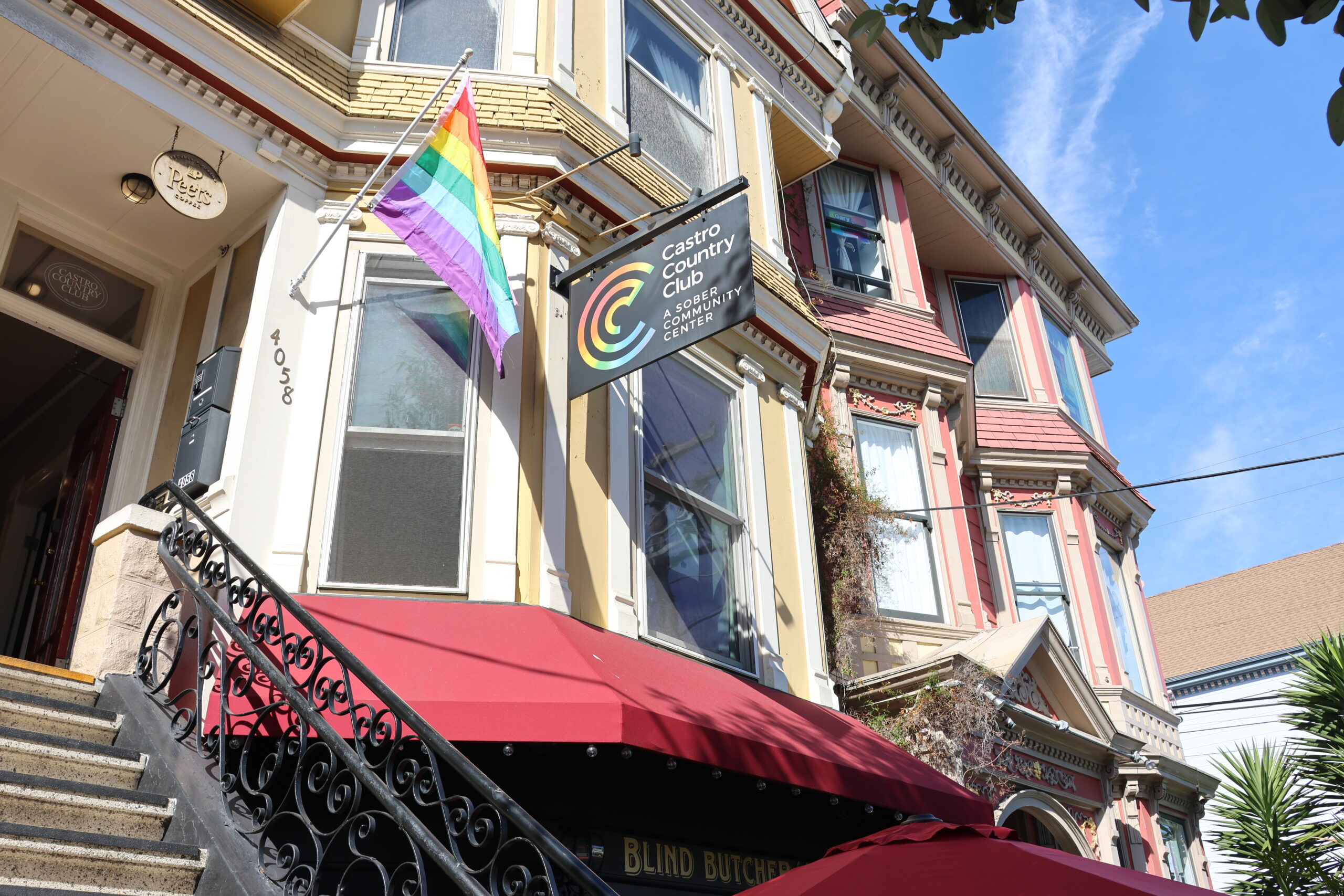
On the front steps of the Castro Country Club, one of the volunteer baristas, Ty, has a running joke. He likes to sweep outside, and when he does, he calls it “step work.”
“Oh, I’m doing my step work.”
In 12-step recovery programs, “step work” means working through the program’s 12 steps, often with a sponsor, as part of maintaining sobriety. The joke lands differently in a place where actual step work happens every day.

Just off Castro Street, the Country Club sits inside a house-like building in San Francisco’s Castro district, a historic LGBTQ neighborhood that became a center of gay political and cultural life in the 1970s. Today, rainbow banners, bars and the landmark Castro Theatre line the streets.

Downstairs, it looks like a neighborhood café. Pastries sit under glass. Flowers brighten the counter. A Peet’s Coffee menu hangs on the wall, and a glass case holds recovery books, medallions and daily readers.
Upstairs, mismatched chairs face the front of a meeting room. Through one of the tall windows, the edge of a Pride flag is visible.

I was 98 days sober when I walked in.
It was my first trip anywhere since entering treatment for addiction in May, and I required permission from my treatment program in Florida to travel to San Francisco for NLGJA Connect. In early recovery, even a work trip comes with logistics that never used to cross my mind: Where is the nearest meeting? Who can I call? What will I do when everyone else goes out drinking?
At the Country Club, I felt at home almost immediately.
In keeping with the anonymity traditions of 12-step fellowships, people in this story are identified by first name only.
For one of the volunteers I met, getting back to a place like this had taken a long detour. Ty has lived in San Francisco for about 38 years. Before his most recent relapse, he had been sober for 23 years. Then an accident left him with a head injury and, he said, the loss of 25 years of memory. Trying to understand how to be “normal” again, he returned to what he remembered from before sobriety: drugs. More recently, fentanyl became part of that relapse.
“But I also found sobriety again, which I’m grateful for,” Ty said.
Now he makes drinks, sweeps the front steps and watches the Country Club fill with people who come for different reasons. Some are headed to meetings. Some meet sponsors to work the steps. Others simply walk in from the neighborhood for coffee.
“I always come here and I get to associate with peers. You know, I get to talk to other people that know where I’m coming from,” Ty said.
“I mean, no one else wants to hear my story, so why not?” Ty said.
That recognition is easy to underestimate until you need it. Outside recovery spaces, the words addict and alcoholic can change the temperature of a conversation. Inside them, there is less translation.
For me, getting sober has meant changing not only what I put in my body but how I understand fun. Drinking and going out once occupied a lot of space in my social life. Remove them and a deceptively simple question appears: What do I do now?
The Castro Country Club was created around a version of that question long before I was asking it. Founded in 1983 as a social alternative to gay bars, it later evolved into a primarily clean and sober space. Today it hosts more than 40 recovery-focused meetings a week, drawing about 40,000 attendees annually. Its café is open 365 days a year and operated by more than 50 volunteers.
The second volunteer I spoke with found the Country Club about a year and a half ago after a social worker recommended it. A self-described coffee nerd, volunteering behind the counter made sense to Echo. Recovery had taken several attempts. Alcohol finally stopped in 2020, but drugs replaced it for a time.
“You don’t have to be in recovery to volunteer, but probably almost all of us are-that’s you know part of our recovery-is service and being in the clubhouse and going to meetings,” Echo said.
The Country Club makes that service visible. A large sign behind the café counter tells visitors that service is “recovery in action” and that the person helping them is a volunteer. The work can be as ordinary as making a latte, stocking cups or giving someone a glass of water.

Earlier that day, a man experiencing homelessness had come by and asked for water. Ty gave it to him. The man appeared unwell, but the point was that he could be offered something small and treated with dignity.
“So we do a service that’s a genuine service to the community, but we also help out people that have definitely less than we have,” Ty said. ’
The Country Club gives something back to its volunteers, too.
“You know, even if you don’t want to talk about your story or what you’re going through, you’re still like, you know, like you don’t have to explain yourself very much,” Echo said.
That line stayed with me. Recovery can be exhausting to translate. A place full of people who already understand can make ordinary things, coffee, studying, sitting outside, feel like part of staying alive.
That matters in the Castro, where nightlife is part of both queer culture and queer history. One volunteer described San Francisco as a place where people come to unwind and let loose.
“It can be a challenge to find sober events,” Echo said.
The Country Club tries to fill that gap not only with meetings, but with campouts, rafting trips, mini golf and other activities.
“Lots of things, lots of activities for people to do just to be together and have fun,” Echo said.
For people who return day after day, it can become something larger.
“It becomes a family for a lot of people,” Echo said.
September is National Recovery Month, observed every year to celebrate recovery and the communities that make it possible. Inside the Country Club, a wall marks September “birthdays,” the sobriety anniversaries of people whose recovery dates fall during the month. Recovery time becomes part of the room, quietly celebrated rather than hidden.

This week, that community will also leave the building. From Sept. 11 to 13, the Country Club’s Recovery Ride will take cyclists from Sausalito to Guerneville and back. The three-day fundraiser supports the Country Club’s programs and includes camping, meals and fellowship. One of the volunteers I interviewed plans to ride.
The event fits the larger idea of the place. Recovery here is not presented only as abstaining from something. It is also doing something: cycling through Marin and Sonoma counties, making coffee, going to a meeting, sweeping the steps or sitting outside with people who understand why you are there.
“Having this place here saved my life,” Ty said.
Before I left, I bought a copy of “Daily Reflections” from the café. I used to have one, but I gave it to my roommate while I was in rehab and never replaced it.

I came to the Castro Country Club as a reporter looking for a story about a queer sober space. I left understanding it more personally. Recovery can sound like a list of things you lose until you enter a place built around what comes next.
Outside, Castro Street was still loud, colorful and full of places to go.
Inside, so was sobriety.