
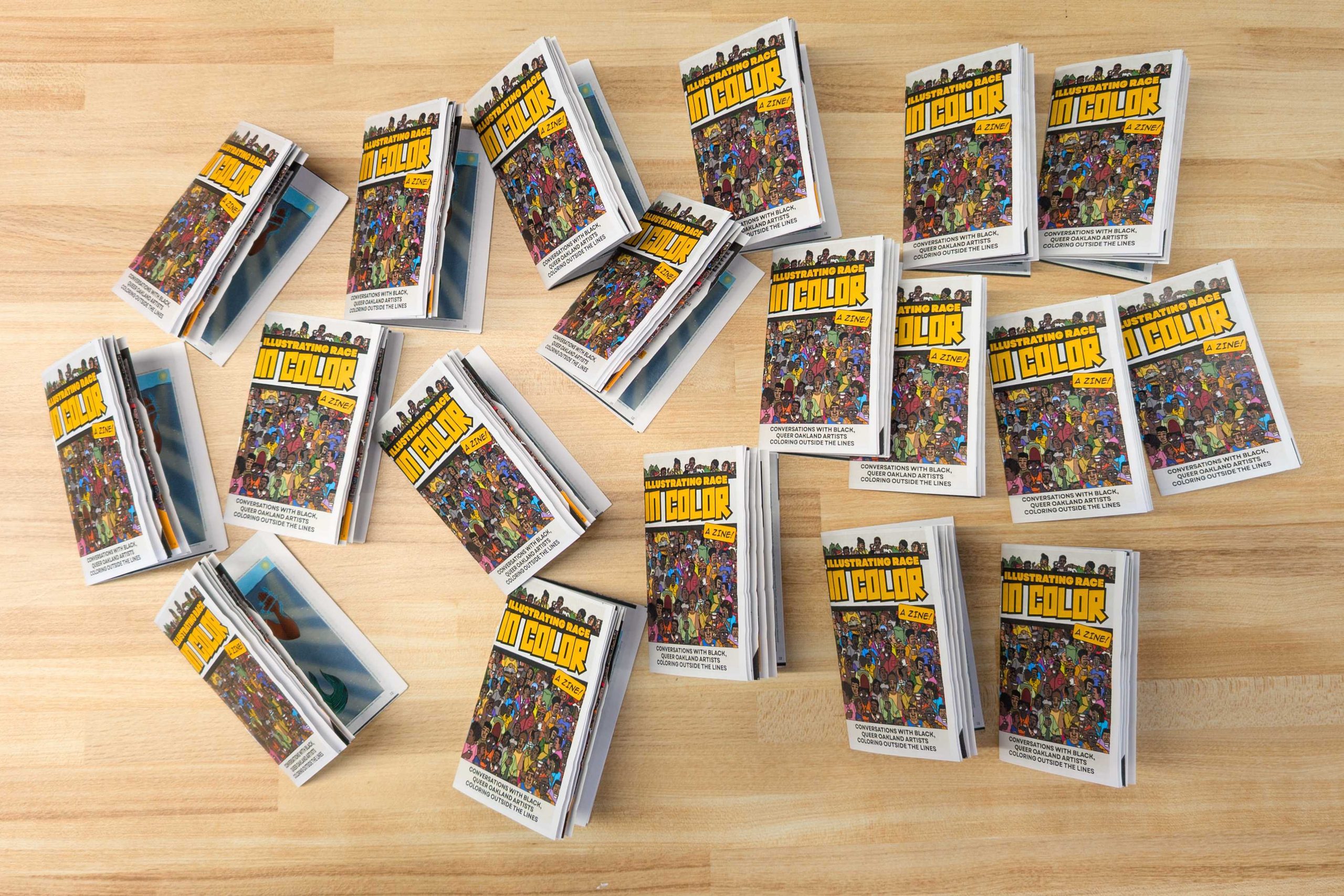
Click through the zine slideshow here, or read the text below!


Background
I enter most spaces looking for the other Black folks in the room. I enter Black spaces looking for the other queer folks. And I enter Black queer spaces looking for the other nerds.
My search for Black queer nerds at the San Francisco Zine Fest marked the start of this weeklong zine project. I immediately hit a jackpot in meeting Ajuan Mance, the esteemed Oakland-based artist, writer and illustrator—the first Black face I noticed. Originally an English professor, her pivot to zinemaking and comics was inspired by her realization that she needed, in her words, to find the other side of her voice.
Sensational illustrations aside, Ajuan’s dedication to uplifting Black, queer creators was striking. She quickly rattled off a list of other Black, queer cartoonists, comic artists, zinemakers and educators for me to reach out to.
Avy Jetter, Oakland-based painter, drawer and self-publisher, was at the top of Ajuan’s list. Avy is the founder of Oakland Creates, a zine and comics fest built to provide opportunities specifically for Black and brown creatives. I was especially honored to talk with Avy, who, only a day out of an intensive surgery, was taking it easy as we spoke. Her strength and energy remained palpable through our conversation as we chatted about her Black queer lens, penchant for space-making, and, most importantly, our shared zombie obsession.
A highlight of this project was getting invited to sit in on one of Ajuan’s classes at the California College of the Arts. To the tune of Charlie Brown soundtracks, I witnessed her students in a pure creation mode in response to Charles Schulz-inspired prompts. I left with a signed copy of Ajuan’s vibrant “Living While Black: Portraits of Everyday Resistance.”
Looking at the note she left inside, and at the quick works of those student creators, I felt, for a moment, like I had been missing out. Comics, during this week, became my portal to an unopened realm of communication linking the inner creativities of the nerdiest among us. Now, I write with the understanding that we have access to an endless amount of portals, through writing, through journalism, and through the ever-expanding world of zines. What follows is a portal: conversational journeys with Bay Area comic titans, Ajuan Mance and Avy Jetter.
These interviews have been edited for length, clarity and structure.

I stopped reading comic books when I was 13,
when I finished my 1,000-page Walking Dead compendium. I was obsessed with zombies as a kid. My first ever article was for a zine called Omega Magazine some nerds were making at my middle school about video games and other nerd stuff. My contribution was a “critical” comparison of the Walking Dead’s TV-show, video games and comic books. In my byline was my gamer tag, SquidBrains. I’ve since removed it from my name (and rebuked it from my spirit), but the sentiment remained. I was a nerd back then. And I still wanna write about comics.

Ajuan Mance Draws From History
Oakland-based illustrator, writer, theorist and historian. Professor of Illustration, previously of English and Ethnic Studies.
Fatima B. Jalloh: What do you think about the sentiment that comics are for kids?
Ajuan Mance: It’s too bad. I didn’t start reading comics regularly until I was in college, when I was reading comics that were not for kids. The Hernández Brothers’ Love and Rockets series changed what I thought comics could be. That’s when I knew, oh, this is the medium for me.
AM: One year into being a professor, I realized art needed to be central. I needed that other part of my voice. And so I taught myself acrylic painting. And then I started to create prints. I proved to myself that I was an artist, and that let me experiment more.

Ajuan started going to zine fests in 2010. Though she’d been in the world of English literature for many years, she felt most at home amongst other creators.
AM: These comics. These people. These zines, about literally anything. I saw the potential of art in narratives about Black history and culture.
Rather than leaving English and ethnic studies behind for the world of zines, Ajuan seamlessly integrated her literary and cultural work with art, community and education.
FJ: How does your own identity influence your portrayal of the world?
AM: A friend of mine was looking at my work and said, ‘you know, you really love Black people.’ And I said, you know, I do. My work is very much motivated by an unconditional love for Black people. Even on a bad day, Black people are still my favorite people.

FJ: How does storytelling come into play in your work? What other themes do you make sure to hit on?
AM: My zines tell stories about Blackness that are—almost—factual. Like, What Do Brothas Do All Day? They eat, they sing and they dance. But my comics all tell mostly autobiographical stories. [My comic book] Gender Studies is episodes from my life, from the perspective of a Black, queer nerd.
Pulling from historical record and archive, Ajuan has recently been transforming newspaper clippings of runaway slaves into a series of portraits.
AM: I’m really interested in telling those Black stories that we’re not allowed to know. So much stuff about Black people that I’ve done zines about, I didn’t know until I was a tenured professor. And if you have to have tenure in order to learn these things, that’s a travesty.

AM: It changed my life to know about the existence of some of these people. It made me feel a sensible belonging I didn’t know I hadn’t felt as a black person. When people were just outraged that the little mermaid was gonna be black, of course, I knew that, there are much, much older mermaid traditions.
FJ: Yeah, and also, like, how Black of a story is The Little Mermaid?
AM: The things she had to give up just to have a piece of it the pie—
FJ: Just to be where the people are.
AM: So I started looking up the mermaids of the Klein Karoo, the water maids in southern Africa. So I did a nice poster about her.

Oakland’s Changing Canvas
FJ: How does the Bay Area compare to your ideal scene?
AM: When I came to Oakland in ‘99, people were already seeing a shift. I’d been in Eugene, Oregon and before that, Ann Arbor, Michigan, and Providence, Rhode Island. So, you know, Oakland was practically Africa to me.
AM: And so a lot of things have been rolled back in terms of support for the arts in San Francisco. And it is a concern. Every time there’s a big tech surge, things get really expensive. The arts thrive regardless—or survive, should I say?
FJ: Do you feel like it has become more tight-knit as a result of that?
AM: One of the things I love is hearing some of the big Black arts organizers talking about how part of their motivation is they love art and their artists. Part of their motivation is to make sure that San Francisco doesn’t get to say whether Black artists have a place in the city or not. The Black artists and the community get to say that.

Avy Jetter Makes Space Off the Page
Oakland-based painter, drawer, self publisher and spacemaker. Founder of Oakland Creates Art, Comics and Zine Fest.
Before starting Oakland Creates, Avy had been going to the Oakland Art Murmur for several years, a gallery primarily featuring white people. She couldn’t shake the feeling of being the ‘other.’
Avy Jetter: They looked at me like I had three heads. They were not really receptive to Black participants. Maybe around the fourth or fifth time, I was like fuck this. I’m gonna create something of my own for brown and Black people to feel included, welcomed and celebrated.
Having previously organized with the San Francisco Zine Fest, Avy knew what she was doing. She set out to organize a fest of her own.

AJ: It was in a friend’s basement. And I didn’t think it’d last more than a year.
In 2025, Oakland Creates celebrated its 10th anniversary. From 200 attendees at that first event to almost a thousand at its latest, Avy’s most memorable experience at Oakland Creates was this past year, as the community she had helped to make space for celebrated her with a plaque for being an Oakland Trailblazer.
AJ: A huge, core memory for me.
AJ: The Oakland area has gone through so many transitions. It used to be a chocolate city. A large percentage of Black people has dwindled. But the core vibe is still the same once you get in certain spaces.
FJ: I’m wondering about your artistic practice, and what that now looks like for you?
AJ: Post-COVID, I started featuring art that was more personal. My personal health struggles. Overcoming anxiety and depression. Building myself up with affirmation. I’ve learned to not be fearful of using myself as the subject matter. That’s been a huge part of my last six years but…

“My first love is gore. Blood and guts.”
Jetter’s most popular comic series, Nuthing Good Ever Happens at 4am, featuring—almost exclusively—characters of color, is an indie comic chronicling a young man’s journey through a “zombie-laden urban landscape of San Francisco.”
FJ: It’s funny because when I was a kid, and arguably still now, I also have a zombie obsession. When Ajuan recommended that I talk to you, the first thing I noticed from your socials was The Walking Dead series that you were doing. And I was like, okay, this is somebody that I need to talk to immediately.
FJ: Do you have a favorite character from the show?
AJ: I think Michonne.
FJ: I was Michonne for Halloween last year.
AJ: Nice.

FJ: What relationships do you have with the Black queer community in the Bay Area?
AJ: I think it’s been really good for me over the past few years as I’ve been an organizer to meet Black people. I think I was more isolated before. Gosh, it’s been so instrumental in me recovering right now. Ajuan stepped up and hired someone to help me make my move. I don’t have enough words of gratitude to say that, that community approach did wonders for me.

ART CREDITS:
Cover: Ajuan Mance
Page 4: Omega Magazine (2015), Kevin “Klockmaster” Kraft
Page 5-14: Ajuan Mance
Page 16-20: Avy Jetter
All art was provided with the explicit permission of the creators for the purpose of this zine.