

By Annika Hauer
September 12, 2026
On June 10, San Francisco Unified School District Superintendent (SFUSD) Maria Su testified before Congress alongside two other superintendents in a three-hour hearing. Representatives on the House Education and Workforce Committee pressed Su on the public school district’s protections for transgender and nonbinary students, including drag queen story hour.
“We welcome all 49,000 students as they are,” Su replied.
Su’s testimony took place amidst threats to pull federal funding over gender identity parental disclosure laws, investigations opened in regards to San Francisco’s trans-inclusive policies, and the Education Department ending discrimination protections for trans students.
But educators in San Francisco are still focused on how to best serve their students who help make up one of the most diverse cities in the country.

A “Culture War” Distraction
“The Trump administration wants to paint these things that we’re indoctrinating young people to be gay,” said Paulie Dellamono, or “Teacher Paulie.” Dellamono teaches 6th grade social studies at Marina Middle School in San Francisco’s Marina district. He didn’t tune into the congressional hearing on June 10, calling it a culture war distraction.
“We’re just trying to be respectful of how people identify,” Dellamono said.
In three years of teaching, Dellamono has taught about 400 students, with two of them being trans. “I try to make my classroom an inclusive space for LGBTQ+ students but also try to be aware of the fact that we have a sizable Muslim population on the campus,” he said, noting the delicate work of balancing varying student needs and identities.
His main concern is that students have gender-neutral bathrooms available for use. Starting this school year, all Californian school campuses are required to have at least one all-gender bathroom.
According to 2023 data from SFUSD, roughly 25% of students identify as bisexual, gay, or lesbian in middle and high school, and 2.4% as transgender. (The same survey from 2025 does not include information about transgender students. Though SFUSD conducted the research on transgender students, the CDC withheld that information in the public report, according to an employee of SFUSD with knowledge on the matter.)
Additionally, 490 of Marina Middle School’s 645 students qualified for free and reduced lunch last year. This meant 75% of the households in the school’s community were at or below 185% of the federal poverty line. Dellamono said many students’ families own businesses in the school’s area but can’t afford to live in the area; resulting in commutes over an hour from Pittsburg or Antioch every day.
Safety and Belonging Are Central Issues
“If people don’t feel safe, they can’t learn,” Dellamono said. “Safety is the number one issue, and part of that is just feeling like you can be who you are, no matter what your race, religion, or identity is. That this is a place that you belong.”
Research has shown that feelings regarding safety and belonging affect student health outcomes and education.
In a study published in 2023, researchers at the CDC found that transgender students and students questioning their gender were more likely than their cisgender classmates to skip school due to feeling unsafe; be threatened or bullied at school; have poor mental health; be in unstable housing; and/or consider and attempt suicide.
Additionally, a study conducted by the National Institute of Health in 2022 found that LGBTQ+ inclusive activities lowered the odds for experiencing violence, poor mental health, and suicidal thoughts and behaviors among all students, regardless of sexual identity.
Where Identity Meets Students’ Needs
Over in the Richmond district, the Richmond Neighborhood Center works within San Francisco public schools to provide students with a free food pantry, after-school programs, and a community space.
Brandon Acuna Embriz, a program manager for Washington High School, said San Francisco’s diversity — in terms of race, gender, sexuality, religion, documentation status, housing stability, and other factors — is intricate within each of his students, making his job both challenging and great.
“We have students that are undocumented, we have students that are going through insecurity with housing, with food insecurity, their identity and how they address themselves is also super important.”
“The students’ lives end up becoming your life,” Acuna Embriz said. “Their situations and things that they trust you [with] ends up becoming something that is on our plate.”
Data Funds Inclusive Activities
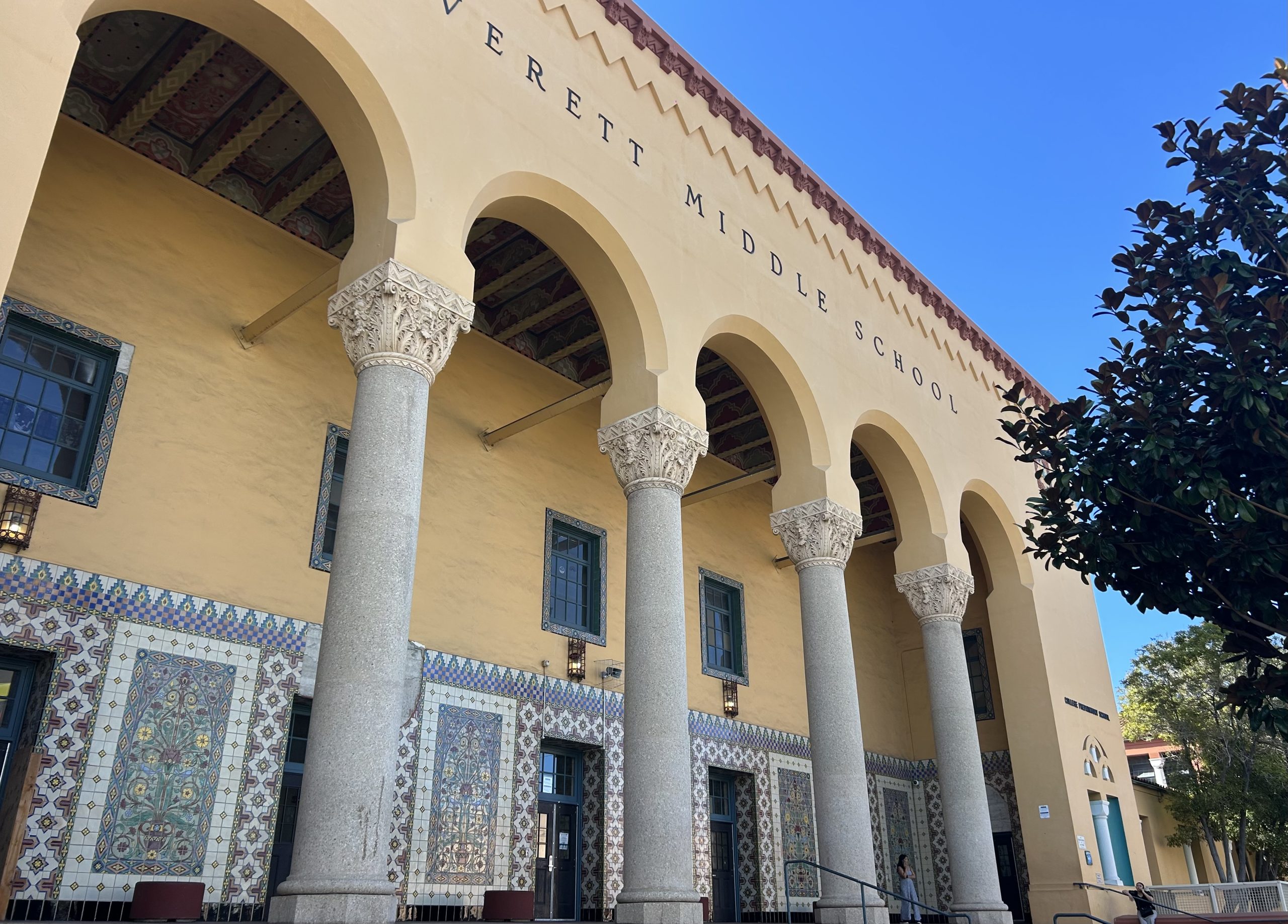
Everett Middle School, a bilingual English-Spanish school, serves the Mission and Castro districts — the epicenter of San Francisco’s gayborhoods.

Head counselor Christopher Herrera, or “Mr. Christopher,” leads Q-Group (more commonly known as GSA) at Everett Middle School, where 65% of the 315 students are Latinx.
“So understanding also what does it mean to be ‘Latinx’ and also queer, and are we as open with our family as we are with maybe other demographics?” Herrera said. “Probably not.”
Q-club’s annual enrollment fluctuates around 10 students out of the total of 300 at the school.
Herrera said he wants to increase awareness about the club among students and make it a more open, drop-in space. He also said he wants to work with families as much as possible.
But cultural differences make this data collection delicate, and federal cuts to collecting gender identity data specifically makes it harder for educators like Herrera to identify who needs support, let alone fund the programs and training to help them.
Last year, when an Everett Middle School student wanted their name changed, Herrera worked together with the child’s parents and a lawyer to make it happen.
“That was cool to see all those pieces work together,” Herrera said. “[As an education professional] you’re trying to do what’s best, but also within your guardrails.”
“The only thing that we do is what we can do.”